Masons
- Players
- 2-4
- Best withThe player count this game plays best at.
- 3 players
- Play timeHow long a full game runs once everyone knows the rules.
- 45 min
- AgeThe minimum age printed by the publisher.
- 8+
- ComplexityHow demanding the rules are, from 1 (very light) to 5 (very heavy).
- 2.1 / 5
- Year
- 2006
About the game
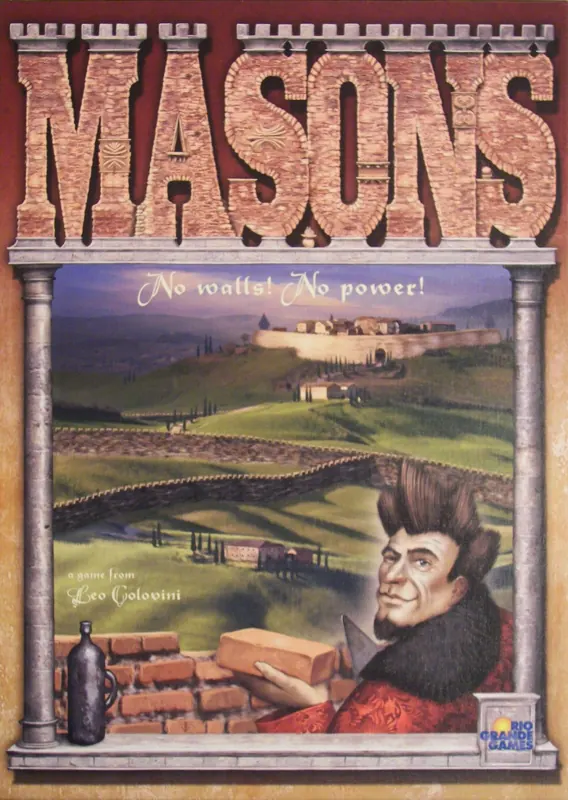
Masons casts players as competing architects who together build cities across a shared landscape. On each turn, a player adds a new wall to the board, which becomes bordered by towers and houses whose colors are determined by dice rolls. When a wall placement fully encloses an area, a new city is formed -- potentially merging with neighboring cities -- triggering a scoring round where players use guild cards to score specific features like house colors, palace counts, or city size. Matching-colored houses inside a city upgrade to palaces, adding another layer of value. The game continues until a set number of pieces are used, with the highest score determining the winning architect.
Hobbli's Notes
Hobbli's editorial team enjoys how Masons blends light dice-driven randomness with clever guild-card timing -- knowing which card to play and when, based on which city is about to complete, is where the real skill lies. The city-building visuals on the table are satisfying to watch grow turn by turn. Designer Leo Colovini's fingerprints are clear in the elegant, interlocking systems, though the dice-determined colors add a layer of luck some strategy purists may not love. It's a solid mid-weight pick for groups who enjoy area-building euro games with a bit of push-your-luck flavor.
What we like
- Clever guild-card timing adds real strategic depth to a simple core loop.
- Satisfying visual growth of interlocking cities across the shared board.
- Dice-driven color assignment keeps every city's development unpredictable.
- Merging cities creates interesting emergent scoring opportunities.
Keep in mind
- Dice-determined colors introduce randomness some strategy-focused players may dislike.
- Scoring can feel opaque to new players until they grasp the guild cards.
- Runs a bit long for its relatively light overall complexity.
Who it's for
Suited to euro-game fans aged 8 and up who enjoy city-building and area-scoring games, best with two to four players.