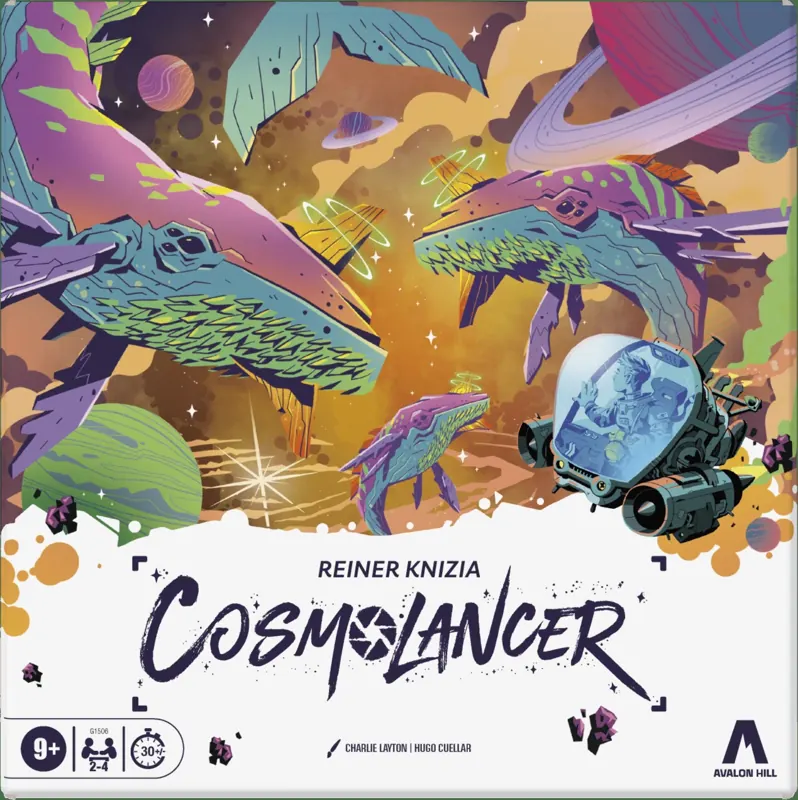
Cosmolancer
- Players
- 2-4
- Best withThe player count this game plays best at.
- 2 players
- Play timeHow long a full game runs once everyone knows the rules.
- 45 min
- AgeThe minimum age printed by the publisher.
- 9+
- ComplexityHow demanding the rules are, from 1 (very light) to 5 (very heavy).
- 1.8 / 5
- Year
- 1994
About the game
Cosmolancer is the newest incarnation of Reiner Knizia's classic tile-laying design, previously known as Auf Heller und Pfennig and Kingdoms, now reskinned with players as freelance space photographers. Across three rounds, players fill a 6x5 grid with tiles that boost or hurt the value of intersecting rows and columns, then place numbered tokens to multiply those totals into their final score. Each round mixes secret tile draws with careful placement decisions, since a well-placed negative tile can devastate an opponent's plans. With 2 to 4 players and a brisk 45-minute playtime, it's an easy game to teach but one with real depth in its scoring puzzle. It's a sharp abstract strategy game dressed up in a fresh sci-fi theme.
Hobbli's Notes
This is a great example of a Knizia design that keeps getting new life through fresh themes without changing what makes it work: a tight, clever multiplier-scoring puzzle. We like that Cosmolancer's tokens numbered 1 through 4 create meaningful decisions about when to commit versus hold back for a bigger score later. The abstract mechanics reward careful row-and-column awareness more than luck. It's a satisfying quick strategy game for players who enjoy elegant, mathematical puzzles.
What we like
- An elegant, mathematically satisfying tile-placement scoring puzzle from a renowned designer.
- Quick to teach and plays in about 45 minutes.
- Secret tile draws and multiplier tokens create meaningful risk-and-reward decisions.
- A fresh sci-fi theme reinvigorates a long-running classic design.
Keep in mind
- The abstract, reskinned theme may feel thin compared to the mechanics.
- Multiplier scoring can create swingy endgame results.
- Offers limited direct player interaction beyond shared board space.
Who it's for
Ideal for abstract strategy fans aged 8+ who enjoy quick, mathematical tile-placement puzzles in groups of 2-4.