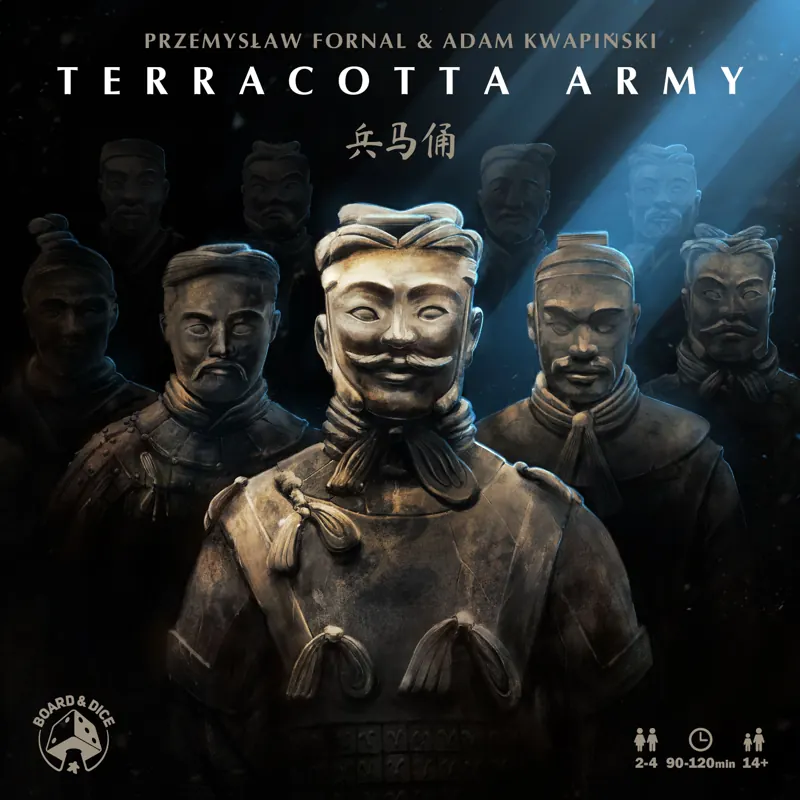
Terracotta Army
- Players
- 1-4
- Best withThe player count this game plays best at.
- 3 players
- Play timeHow long a full game runs once everyone knows the rules.
- 120 min
- AgeThe minimum age printed by the publisher.
- 14+
- ComplexityHow demanding the rules are, from 1 (very light) to 5 (very heavy).
- 3.4 / 5
- Year
- 2022
About the game
In Terracotta Army, players take on the role of master craftsmen tasked with building Emperor Qin Shi Huang's legendary funerary army. Over five rounds, you collect resources, upgrade workers, and curry favor with the Emperor's advisors while placing warrior miniatures into shared formations within the mausoleum. Scoring rewards both domination (having the most of a resource or statue type) and presence (having at least one), creating constant tension between cooperation and competition. With deep worker placement and area-majority mechanics, it's a hefty strategic centerpiece for serious gamers. The player with the most victory points after the fifth round claims victory.
Hobbli's Notes
Hobbli's editorial team appreciates how Terracotta Army layers area-majority scoring onto a solid worker-placement chassis, giving every placement real tactical weight. The theme is handled thoughtfully and the miniatures make the shared mausoleum board a great visual centerpiece. It's a fairly heavy, slow-building game that rewards planning several rounds ahead. Newer strategy gamers may find the domination/presence scoring math a bit fiddly at first.
What we like
- Rich worker-placement system with meaningful upgrade paths.
- Area-majority scoring creates constant tactical tension.
- Strong historical theme brought to life with detailed miniatures.
- High replayability due to variable setup.
Keep in mind
- 120-minute playtime and high complexity limit casual play.
- Domination/presence scoring can be confusing for newer players.
- Significant downtime between turns in full player counts.
Who it's for
Best suited to experienced strategy gamers aged 14+ playing in groups of 2-4 who enjoy worker placement and area-control tension.