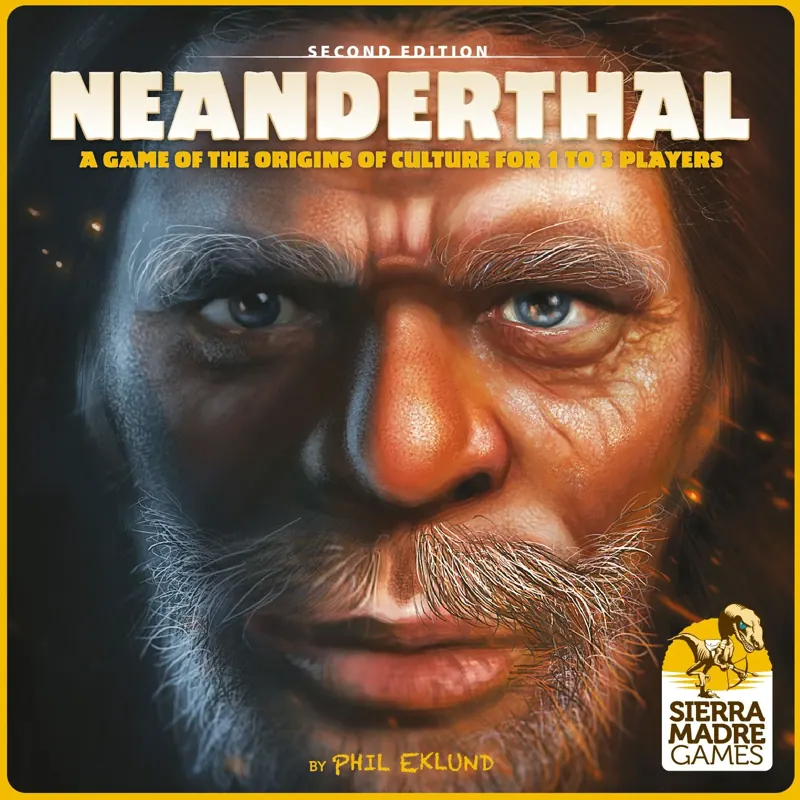
Neanderthal
- Players
- 1-3
- Best withThe player count this game plays best at.
- 3 players
- Play timeHow long a full game runs once everyone knows the rules.
- 120 min
- AgeThe minimum age printed by the publisher.
- 14+
- ComplexityHow demanding the rules are, from 1 (very light) to 5 (very heavy).
- 3.8 / 5
- Year
- 2015
About the game
Neanderthal is a heavy simulation game set in Ice Age Europe, 43,000 BC, where 1-3 players guide one of three human species - Archaic, Neanderthal, or Cro-Magnon - through survival and cultural development. Players assign males to hunt dangerous megafauna, women to teach children and build culture, and elders to specialize in fire, war, invention, or animal domestication, all while choosing between different mating strategies. Designed by Phil Eklund, it uses auction, dice, and negotiation systems to model prehistoric competition for survival and advancement. The game flows directly into its companion title, Greenland, for an extended playthrough.
Hobbli's Notes
Hobbli's team respects Neanderthal as a dense, thinky simulation typical of Phil Eklund's design style, packing serious anthropological and evolutionary detail into its systems. The mating-strategy choice and victory conditions genuinely shift based on your approach, giving real strategic identity to each species. It's a demanding game that rewards patient, analytical players. Casual gamers or those new to Eklund's dense rulebooks may find the learning curve steep.
What we like
- Deep, historically grounded simulation of prehistoric survival.
- Multiple mating and development strategies create distinct playstyles.
- Connects seamlessly into the companion game Greenland.
- Rewards careful, long-term strategic planning.
Keep in mind
- High complexity and dense rules create a steep learning curve.
- Long playtime demands a serious time commitment.
- Niche theme and design style won't appeal to casual gamers.
Who it's for
Best for experienced strategy gamers ages 14+ who enjoy dense historical simulations, in groups of 1-3.