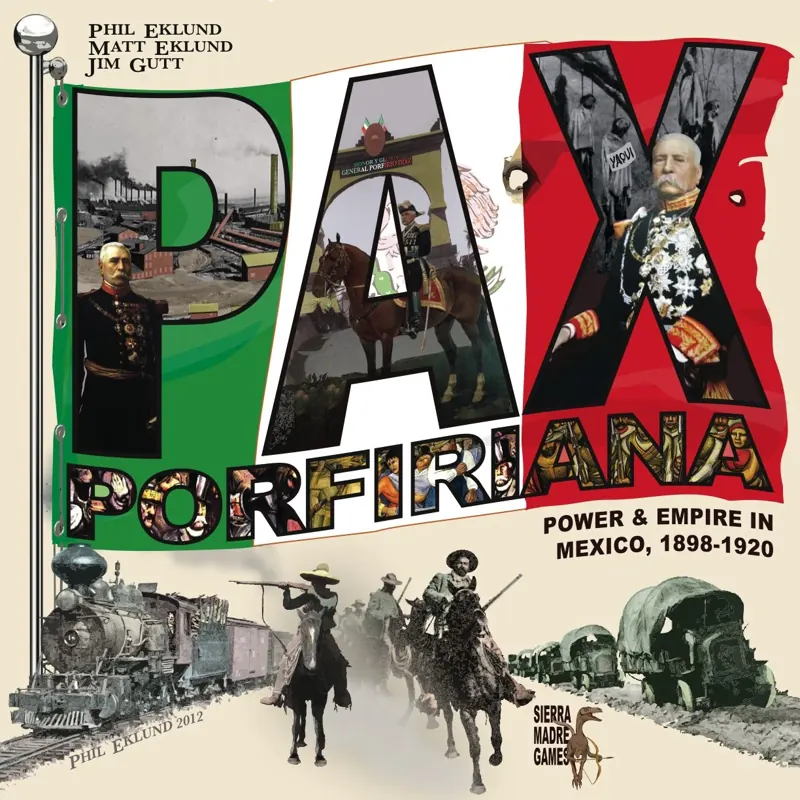
Pax Porfiriana
- Players
- 1-6
- Best withThe player count this game plays best at.
- 4 players
- Play timeHow long a full game runs once everyone knows the rules.
- 120 min
- AgeThe minimum age printed by the publisher.
- 12+
- ComplexityHow demanding the rules are, from 1 (very light) to 5 (very heavy).
- 3.6 / 5
- Year
- 2012
About the game
Pax Porfiriana casts players as rich businessmen building empires of ranches, mines, rail, troops, and banks in the turbulent borderlands of pre-revolutionary Mexico. Each turn allows three actions such as playing cards, buying from the market, speculating, purchasing land, or redeploying troops, all set against the backdrop of dictator Porfirio Díaz's crumbling regime. Victory can come from toppling Díaz through coup, revolution, or annexation, or simply by accumulating the most gold if he remains in power. With 220 cards in the box but only a portion used each game, no two sessions play out the same way. It's a dense, asymmetric card-driven economic and political struggle from designer Phil Eklund.
Hobbli's Notes
Pax Porfiriana rewards players who love untangling asymmetric card interactions and building an engine from a shifting, chaotic market. The historical grounding in the Mexican Revolution gives real substance to what could otherwise feel like an abstract card game. Its dense iconography and steep learning curve make it a genuine investment before it clicks. A cult favorite for fans of Eklund's uniquely cerebral, thematic design style.
What we like
- Deep asymmetric card-driven economy with multiple win conditions.
- High replayability thanks to a massive rotating card pool.
- Rich historical theme grounded in the Mexican Revolution.
- Rewarding for experienced strategy gamers who enjoy engine-building.
Keep in mind
- Steep learning curve with dense, unusual iconography.
- Significant downtime possible in full multiplayer games.
- Can feel inaccessible to newcomers unfamiliar with Eklund's designs.
Who it's for
Best for experienced strategy gamers aged 14+ who enjoy dense, asymmetric card-driven economic games, in groups of up to six or solo.