First Contact
- Players
- 2-7
- Best withThe player count this game plays best at.
- 6 players
- Play timeHow long a full game runs once everyone knows the rules.
- 40 min
- AgeThe minimum age printed by the publisher.
- 12+
- ComplexityHow demanding the rules are, from 1 (very light) to 5 (very heavy).
- 2.0 / 5
- Year
- 2018
About the game
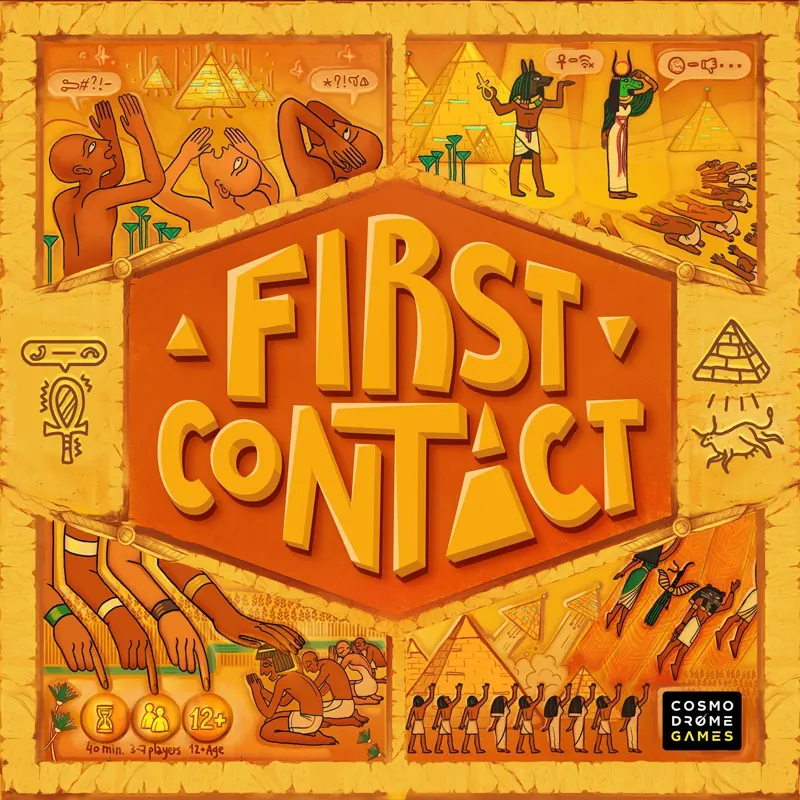
First Contact is a humorous party game of imaginary ancient Egyptians trying to communicate with visiting Aliens through drawn symbols. Aliens sketch strange glyphs hinting at earthly souvenirs they want to collect, while the Egyptian players puzzle out the meaning through shared deduction and creative guessing. As Aliens race to grab souvenirs and fly home, Egyptians compete to become the best interpreters of the alien language. It's a quirky, associative deduction game for larger groups that thrives on humor and lateral thinking.
Hobbli's Notes
Hobbli's team finds the sci-fi-meets-ancient-Egypt premise of First Contact genuinely fun and different from typical party game themes. The symbol-drawing communication mechanic keeps rounds fresh since no two 'alien languages' play out the same way. It scales nicely for larger groups, which is always a plus for party games. We haven't had extensive hands-on time with this particular title, so we'd suggest trying a round before committing to a big game night lineup.
What we like
- Unique symbol-drawing communication mechanic keeps every game fresh.
- Humorous alien-meets-ancient-Egypt theme adds real charm.
- Scales well for groups up to 7 players.
- Quick 40-minute sessions fit easily into a party lineup.
- Rewards creative, associative thinking over rote strategy.
Keep in mind
- Communication-limit mechanic may frustrate more literal-minded players.
- Humor and cultural references may not land equally for every group.
- Deduction difficulty can swing wildly based on the symbols drawn.
- Less strategic depth than dedicated deduction games.
Who it's for
Fun for party game groups who enjoy associative and communication-based deduction, ages 8-12 and up, in groups of 2-7.